
The PDCA cycle or Deming wheel: how and why to use it

PDCA-en
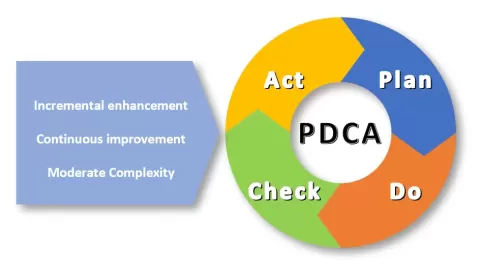
The PDCA cycle, often referred to as the "Deming Wheel" in honor of W. Edwards Deming, is an iterative method for continuous process or product improvement. The acronym PDCA stands for Plan, Do, Check, and Act.
Continue reading
  24436 Hits

DMAIC process: a methodology to implement six sigma

DMAIC process

1 What is the DMAIC process?

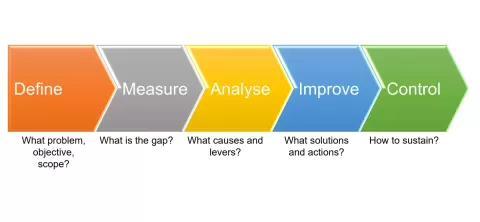
The DMAIC process is a structured continuous improvement process that aims to optimize processes and reduce variations in a business, industrial or transactional process. The acronym DMAIC stands for "Define", "Measure", "Analyze", "Improve" and "Control".
Continue reading
  13694 Hits

Ishikawa diagram and root cause analysis

Ishikawa root cause analysis diagram
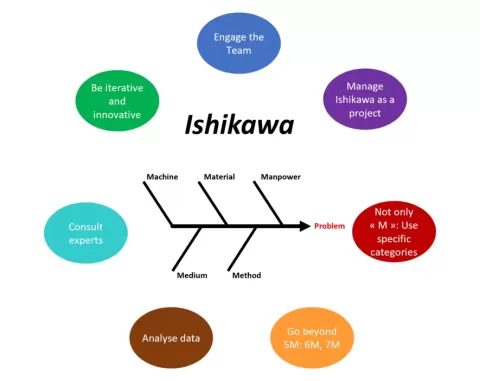
The Ishikawa diagram, also known as the fishbone diagram or cause and effect diagram, is a problem-solving method centered on cause analysis to identify root causes. This technique was developed by Dr. Kaoru Ishikawa, a Japanese quality management expert.
Continue reading
  24468 Hits

8D method (8 disciplines)

8D problem solving method
The 8D (8 Disciplines) method is a structured approach to problem solving. It is often used to address quality issues in manufacturing, but it is applicable to a variety of sectors and situations.
Continue reading
  9786 Hits

A3 is a principle, not a problem-solving method !!

A3-method-en
No, the "A3 method" is not a problem-solving method! It's a principle used during problem solving that encourages brevity and clarity and facilitates communication.
Continue reading
  4015 Hits

The 5 whys method: how and when to use it

5 Whys method

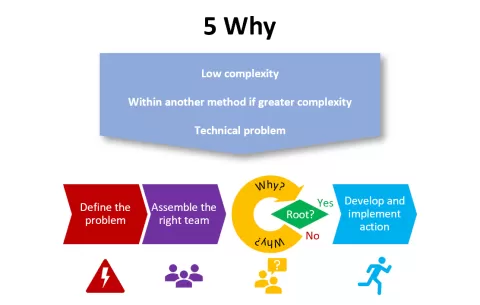
The "5 Whys" method is a technique used to understand the root causes of a problem. It was originally developed by Taiichi Ohno, the chief engineer of the Toyota production system.

Continue reading
  14895 Hits

What is an operational audit of the organisation?

What is an organisation diagnostic?

An operational audit of an organisation consists in evaluating the organization of a company. But the scope of the organisation is so vast (strategy, governance, functions, leadership, business processes, tools and information systems...), and the objective of the audit so varied, that no two audits are the same.

Continue reading
  6559 Hits

Comparison of problem-solving methods and techniques

Methods and techniques for problem solving

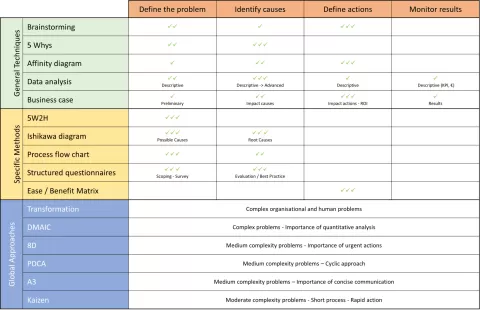
Problem-solving is an essential skill in everyday life, in the professional world, and even in scientific research. However, with the multitude of approaches, methods, and techniques available, it can be challenging to navigate. Each problem is unique and may require a different approach. We will attempt to clarify the landscape of these approaches and methods by explaining their primary differences and when to use them, all summarized in the image above.

Continue reading
  19487 Hits

5W2H or 5W1H methods: how and when to use them

5W2H method

The 5W2H method is a tool used to facilitate the analysis, understanding, or description of a situation or a problem. It helps to gather all essential information in a structured manner. The definition of 5W2H is: What, Who, Where, When, How, How many, Why.

Continue reading
  36919 Hits