


Workplace conflicts lead to very high losses, not only financially but also in terms of employee well-being and effectiveness. However, very few managers are trained to prevent and manage conflicts in their teams. And most importantly, it is crucial to identify the real causes of conflicts because they are not as personal as one might think.

The Paternalistic Leader behaves in a protective and Paternalistic manner towards his subordinates. It is often compared to a parent-child relationship, where the leader takes care of his employees and expects their loyalty and respect in return. The Paternalistic Leadership is often associated with traditional or family cultures, where hierarchy and personal relationships are important.

Authentic Leadership is based on the leader's transparency, honesty, and sincerity towards their collaborators. The Authentic Leadership is founded on self-awareness and understanding one's values, beliefs, and emotions, as well as authenticity in how these values, beliefs, and emotions are expressed and shared with others.

The Situational Leadership is a model that proposes that the most effective Leadership behaviour depends on the situation. The main idea of this model is that leaders must be flexible and adapt their Leadership behaviour according to the competence and motivation level of their subordinates

Servant Leadership is a philosophy and a set of practices that enrich the lives of individuals, build better organizations, and ultimately create a more just and caring world. This Leadership type focuses on serving others, emphasizing the development and well-being of individuals and communities to which a leader serves.

Visionary Leadership is characterized by a leader's ability to create a clear and inspiring vision of the future, and to motivate and inspire others to work together to achieve that vision. Visionary Leaders are generally charismatic, passionate, and have a strong belief in their vision. They are also open-minded, creative, and able to think strategically.

The 5W2H method is a tool used to facilitate the analysis, understanding, or description of a situation or a problem. It helps to gather all essential information in a structured manner. The definition of 5W2H is: What, Who, Where, When, How, How many, Why.
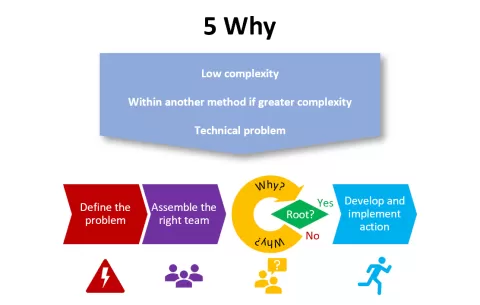
The "5 Whys" method is a technique used to understand the root causes of a problem. It was originally developed by Taiichi Ohno, the chief engineer of the Toyota production system.
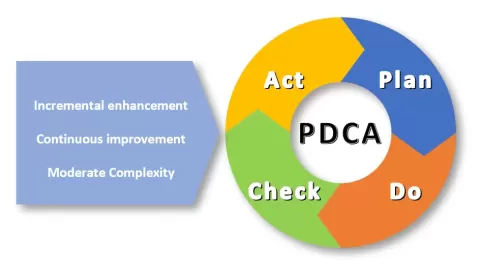
The PDCA cycle, often referred to as the "Deming Wheel" in honor of W. Edwards Deming, is an iterative method for continuous process or product improvement. The acronym PDCA stands for Plan, Do, Check, and Act.

No, the "A3 method" is not a problem-solving method! It's a principle used during problem solving that encourages brevity and clarity and facilitates communication.

The 8D (8 Disciplines) method is a structured approach to problem solving. It is often used to address quality issues in manufacturing, but it is applicable to a variety of sectors and situations.
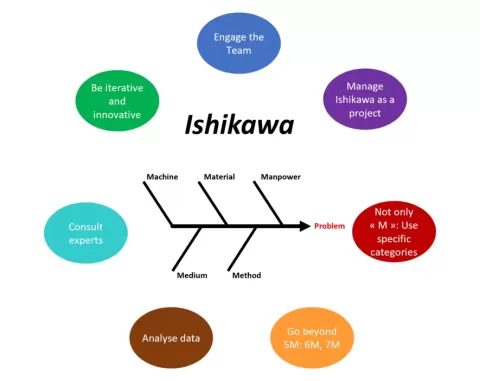
The Ishikawa diagram, also known as the fishbone diagram or cause and effect diagram, is a problem-solving method centered on cause analysis to identify root causes. This technique was developed by Dr. Kaoru Ishikawa, a Japanese quality management expert.
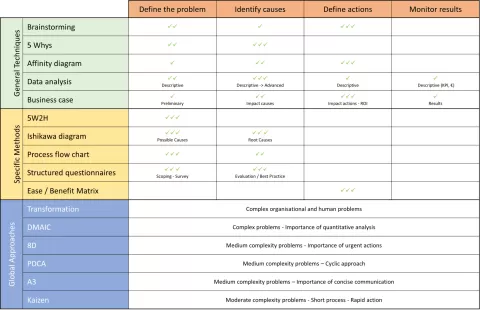
Problem-solving is an essential skill in everyday life, in the professional world, and even in scientific research. However, with the multitude of approaches, methods, and techniques available, it can be challenging to navigate. Each problem is unique and may require a different approach. We will attempt to clarify the landscape of these approaches and methods by explaining their primary differences and when to use them, all summarized in the image above.

The SIPOC (Supplier, Input, Process, Output, Customer) is a widely used type of process mapping in quality management and continuous improvement.

Process mapping is a method used to visualise and understand the stages of a process within an organisation, for example using a flow chart.

Waste reduction (mudas in Japanese) is a central concept in the Lean philosophy which seeks to minimize them while maximizing productivity and increasing customer satisfaction.

Bureaucratic Leadership emphasizes rules and procedures to manage organizations and employees. Bureaucratic Leadership is based on a formal and hierarchical organizational structure, where decisions are made by following established guidelines and policies.

Charismatic Leadership relies on the personal appeal and charisma of the leader to inspire and motivate their collaborators. Charismatic Leaders are often perceived as being visionary, energetic, and capable of eliciting a deep and emotional commitment from their collaborators.

The Laissez-Faire Leadership is characterized by a high degree of autonomy granted to team members. The Laissez-Faire leader intervenes little in decision-making processes and allows their subordinates to make their own decisions and manage their work independently

The Democratic Leadership, also known as Participative Leadership, is a management type where the leader makes decisions after consulting with their team. The Democratic Leader encourages and facilitates the active participation of team members in the decision-making process.